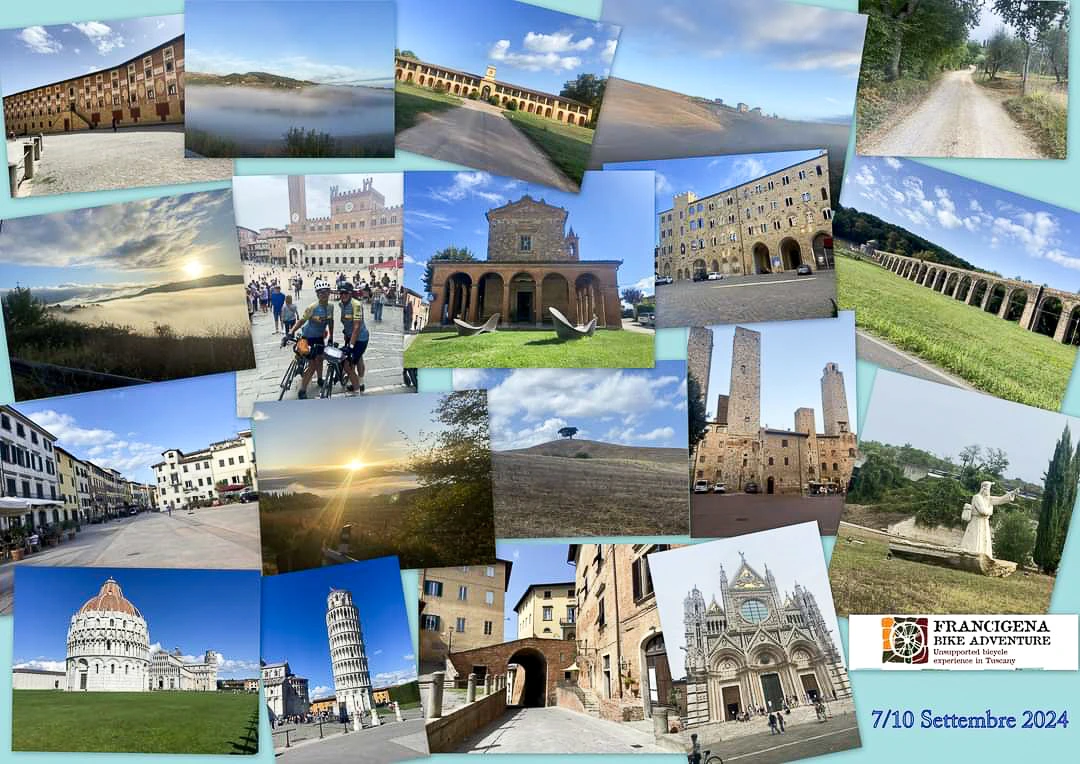
The itinerary of the Via Francigena does not exactly coincide with the ancient Roman consular roads and, over the centuries, has undergone numerous variations determined by the intertwining of historical, political, and climatic factors.
The first written mention of the term "Francigena" dates back to 876 in a parchment preserved in the Abbey of San Salvatore on Mount Amiata, referring to a stretch of road near Chiusi, in the province of Siena. However, the first detailed description of the route dates back to 990, when Sigeric, Archbishop of Canterbury, noted the churches visited in Rome and precisely outlined the 79 stages of his journey back to Canterbury, highlighting the stopping points along the itinerary.
In Tuscany, this route touched places of great charm. Starting from Luni and crossing the picturesque Apuan Alps, it passed through Pietrasanta and Lucca, which attracted numerous pilgrims from distant regions of Europe for its famous relics. Continuing through various stages such as Porcari, Altopascio, and Fucecchio with its bridge over the Arno, the Via reached San Genesio (San Miniato) before ascending the Valdelsa, passing through San Gimignano, Colle di Val d'Elsa, Castelfiorentino, Certaldo, and Poggibonsi before reaching Siena.
Siena, thanks to its position on the Francigena, experienced significant development in the Middle Ages. From there, the route followed the Arbia Valley towards San Quirico d'Orcia, the Val d'Orcia, then crossed over into the Val di Paglia and descended to Acquapendente. Subsequently, due to the insecurity of the Val di Paglia, travellers preferred to pass through the Rocca di Radicofani. The journey continued through Bolsena, Montefiascone, Viterbo and other locations, until reaching Rome.
In 1994, the Via Francigena was recognised as a 'European Cultural Route', obtaining a supranational status similar to the Camino de Santiago de Compostela.